
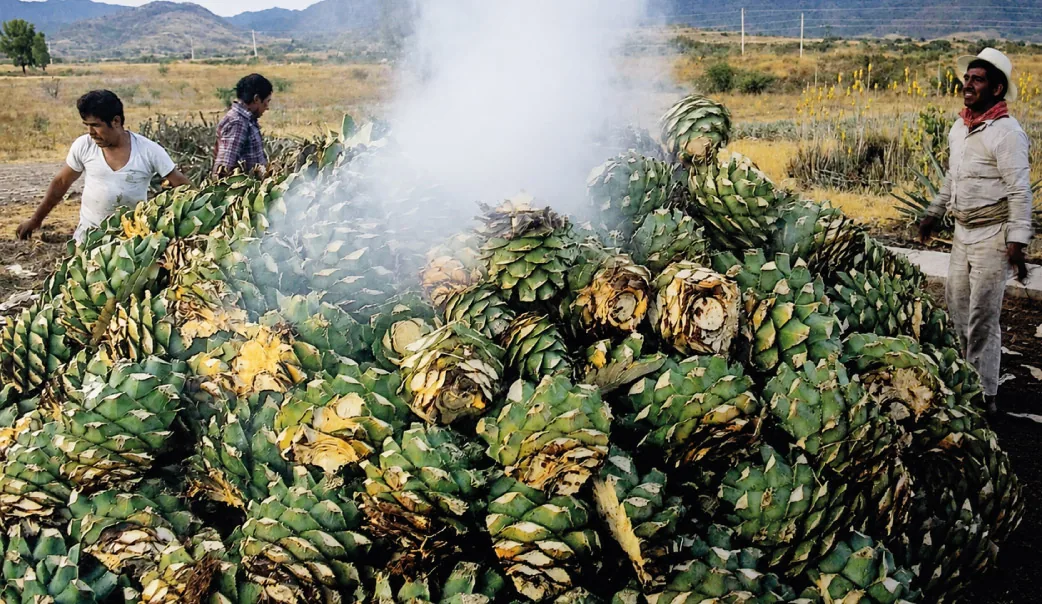
HISTORY
PEOPLE AND THE AGAVE
For ten thousand years, the people of Mesoamerica have shared their fate with the maguey.
People and the agave
The relationship between people and the maguey began some ten thousand years ago, when the inhabitants of Mesoamerica still lived as nomads. As they settled, they domesticated the agave, as they had other crops, and from then on the plant accompanied rain-making rites, the gathering of harvests, the ceremonies of certain gods and rites of passage: it was not merely a resource but a calendar, an offering and a homeland.
Mexico is home to a great diversity of agaves, above all in its semi-arid regions. There are more than a hundred varieties, with different names and uses from one region to the next. That botanical wealth is a cultural wealth too: every maguey names a landscape and a way of living in it.
The meztl, or maguey
It belongs to the agave family. Its leaves — large, stiff and fleshy, with spiny edges and a prominent spike at the tip — are arranged in a pyramid-shaped rosette.
They are made of a fibrous tissue whose sap yields a drink that brings on cheerfulness and a pleasant drowsiness.
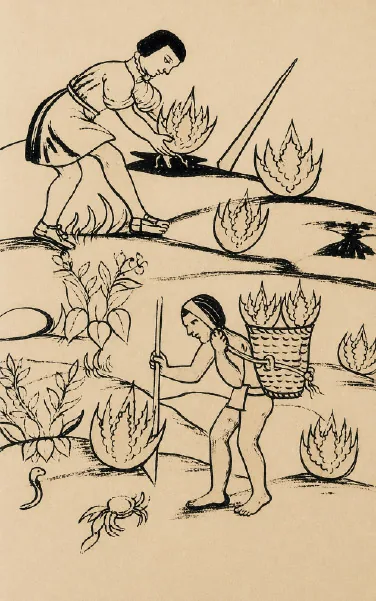
Florentine Codex
The Florentine Codex records how the peoples of Mesoamerica knew and grew the agave species that met their needs for clothing and food. Its illustrations document everyday life with the maguey: its harvest, its transport and its place in community life. That visual memory explains why, millennia later, more than a hundred varieties still exist side by side — each with its own name and purpose depending on the region.
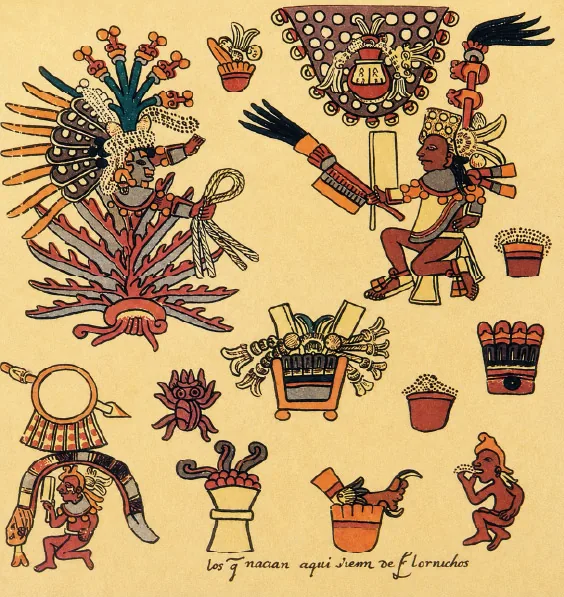
Codex Borbonicus
The maguey is far more than a raw material: it is a symbol of identity, resilience and belonging. In the Codex Borbonicus, the agave appears intertwined with ritual and ceremony — the visual memory of a culture that saw the maguey as the axis of its land and its life. Ceremonies, offerings and rain rites found in its heart a bond between the earth and the sacred.
According to a Mixtec legend, Princess Mayahuel discovered how to draw a delicious, intoxicating liquid from the heart of the meztl. With the arrival of the Spanish, the plant came to be called maguey.
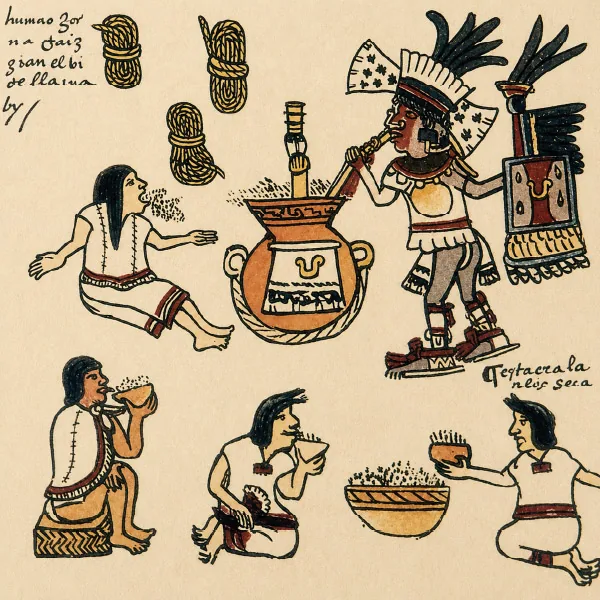
Codex Magliabechiano
The Codex Magliabechiano documents the uses of the maguey and the ancestral practices linked to its distillation and consumption. Root, fibre, food and drink come together in a single plant that has accompanied people from the soil to the glass. From that heart, mezcal was born too. Growing it takes care to keep pests at bay; some of them, such as the agave worm, were put to use and became part of the tradition of Oaxacan mezcal.
A tradition handed down
Despite the arid, desolate landscape in which the agave grows, and however easy it is to come by other spirits, Oaxaca’s mezcal makers have always stood up for their own. Production has endured as a family and cultural tradition, handed down from grandparents to parents and from parents to children. The ritual purity of how it is made is no museum piece: it is a living craft, taught at the palenque and in the fields.
As the country developed economically, production grew beyond the regional market. Today mezcal is sold nationally and internationally too — while remaining, at its root, the age-old bond between people and the agave.